A fight over circumcision is giving Europe a taste of the new US diplomacy

A fight over circumcision is giving Europe a taste of the new US diplomacy
Europe has long been a favored posting for US diplomats, offering spacious residences and a relatively tranquil lifestyle—particularly west of Kyiv. Daniel Fried, a former US ambassador to Poland, noted that such posts come with the advantage of being in “friendly territory.” Disputes, when they arise, can often be resolved privately. However, recent public disagreements between three US ambassadors and their European counterparts have introduced a sharper tone to US diplomacy, echoing the assertive style of the Trump administration.
Belgium’s Circumcision Controversy
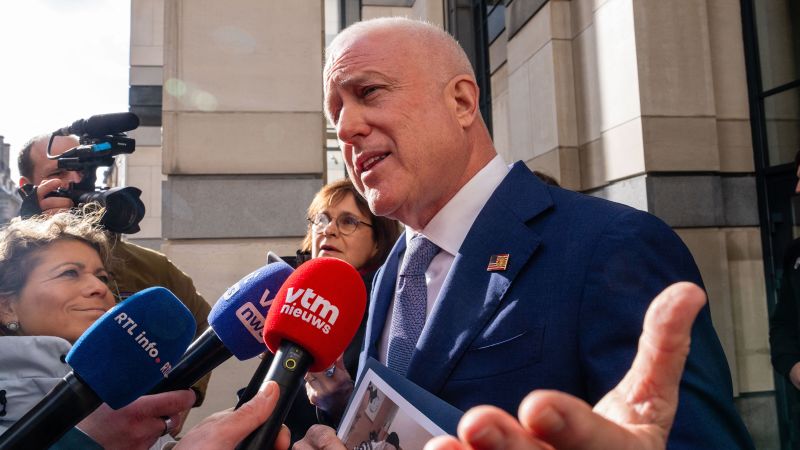
Bill White, the US ambassador to Belgium, recently sparked controversy by criticizing the country’s handling of Jewish ritual circumcision. He highlighted a case in Antwerp involving three mohels—ritual circumcisers—who faced judicial scrutiny after allegedly performing procedures without medical oversight. In a post on X, White demanded that Health Minister Frank Vandenbroucke step in to halt the investigation. “Belgium must drop the ridiculous and anti-Semitic ‘prosecution’ of the three Jewish religious figures in Antwerp,” he wrote, adding that the men had been trained for millennia to carry out their duties.
“It was clear that you dislike America, the country that fought and where tens of thousands of our nation’s sons died for Belgium’s freedom twice,” White claimed, accusing Vandenbroucke of being “very rude” and refusing to engage with him.
Belgium’s Foreign Minister, Maxime Prévot, responded by calling White’s remarks “false, offensive, and unacceptable.” He emphasized that the country allows ritual circumcision as long as it’s performed by qualified physicians under strict health guidelines. Prévot also stated that White had been summoned for a meeting to address his outburst. “An ambassador must respect our institutions and judicial independence,” he said, pointing out that public attacks on officials and interference in legal matters breach standard diplomatic practices.
Broader Diplomatic Tensions
The spat in Belgium mirrors earlier incidents, such as the accusation of antisemitism leveled by Charles Kushner, US ambassador to France, against President Emmanuel Macron. In a letter to the Wall Street Journal, Kushner—father of Donald Trump’s son-in-law—alleged Macron had failed to address rising antisemitism. Macron retorted that the letter was a “mistake” and an “unacceptable statement” for a diplomat.
Meanwhile, in Poland, US ambassador Tom Rose recently announced plans to cut ties with Włodzimierz Czarzasty, the speaker of the lower house of parliament. Czarzasty had criticized Trump for not earning the Nobel Peace Prize he desired. Rose labeled the speaker’s remarks as “outrageous and unprovoked insults,” arguing they had damaged US-Polish relations. Prime Minister Donald Tusk, who leads a center-left coalition in the Sejm, countered by stating, “Allies should respect, not lecture, each other.”
A Shift in Diplomatic Style
Former ambassador Daniel Fried, who served in Poland from 1997 to 2000, observed that these incidents reflect a departure from traditional diplomacy. He told CNN that while a diplomat’s role is to promote the president’s agenda, it doesn’t always require defending the president from all criticism. “You learn to navigate the politics of the host country,” Fried said, “sometimes ignoring attacks to focus on progress.”
Fried acknowledged Rose’s efforts in Warsaw but warned that public confrontations on foreign soil could lead to losses. “You will seldom win a fight on someone else’s ground,” he cautioned. The Trump administration, however, appears to relish such battles, with its approach to Europe seeming more combative than cooperative.